The issue of race has become such an integral part of our culture. There are distinct divisions between black and white neighborhoods and stereotypes fill social media. This wasn't always a widespread issue, shown in The Color of Water by James McBride. He wrote the rest of his novel in the same fashion as before, with chapters illustrating his own life and then his mother's journal entries in between. The first half of the book centered on the fact that people would look at McBride weirdly as a child because of the difference between the dominate race in the neighborhood and his mother's skin color, yet as a child, he was blissfully unaware. The second half of the book focuses more on how his mother influenced him using her ideas on race, religion, and education.
At first, I thought that the book's purpose was to establish a different perspective on race. Usually, the books on race involve tales of those fighting for their freedom or against segregation, yet this novel was completely different. It showed a white woman living in the world of the black race and how she kept her head high and acted honorably even when everyone discriminated against her. While it was first believed that McBride's idea was to show how prominent the idea of race could really be, after reading the rest of the story, it displayed something else: He wanted to express his feeling that to understand the present, one must be familiar with the past. Towards the end of the book, McBride explains, "I felt like a Tinkertoy kid building my own self out of one of those toy building sets; for as she laid her life before me, I reassembled the tableau of her words like a picture puzzle, and as I did, so my own life was rebuilt." This comes from his description of the idea that his mom's life was completely bound to his, and that his mother's history helped him understand his own life. Also, to more understand McBride's dual racial identity, he needed to know what happened to his mother and why she would choose to make a family with a black man as a white woman even with all of the ridicule.
Sunday, April 17, 2016

Sunday, April 10, 2016
TOW #23: "How Not to Explain Success"
This article was found at nytimes.com.
There are many ways to define one's success. One individual might believe they are successful for the rest of their life if they win a basketball trophy in the seventh grade, while someone else bases their conclusion on raising a healthy family and avoiding divorce. The author of this article was looking at another book that said success depended on a certain combination of three specific traits: a belief that their group was superior to others, a sense of personal insecurity, and a high degree of impulse control. Christopher Chabris and Joshua Hart then made this their own personal argument and tried to figure out a way to prove it without including all of the anecdotes and stereotypes that were in the original book.
One way they were able to create some specific evidence and avoid stereotypes was through two online surveys. They surveyed 1,258 adults in the United States where the participants had to complete a variety of standard questionnaires to measure his or her impulsiveness, ethnocentrism, and personal security (all of the components of success). After this, the participants completed a test of their cognitive abilities, so they reported their income, occupation, education, and other achievements that could have defined their success. After the data was analyzed by the authors, it was found that more successful people, based on these standards anyway, had parents that were more educated, made more money, and had higher cognitive ability. Also, it was seen that more successful participants did not possess greater feelings of ethnocentrism or personal insecurity, and actually the opposite was true.
The authors of this article had an argument that they tried to prove right through an experiment that actually showed the exact opposite of what they were trying to prove true. So, they obviously didn't pick good enough evidence for their topic and actually disproved their argument. This might have been their purpose, to abolish a theory that seemed weird to them, and I believe it to have been achieved. Their evidence didn't help their argument, but it allowed them to show this interesting theory and disprove it. They could've helped their argument by including other types of evidence like more statistics or personal stories that could've further explained what they were trying to say.
There are many ways to define one's success. One individual might believe they are successful for the rest of their life if they win a basketball trophy in the seventh grade, while someone else bases their conclusion on raising a healthy family and avoiding divorce. The author of this article was looking at another book that said success depended on a certain combination of three specific traits: a belief that their group was superior to others, a sense of personal insecurity, and a high degree of impulse control. Christopher Chabris and Joshua Hart then made this their own personal argument and tried to figure out a way to prove it without including all of the anecdotes and stereotypes that were in the original book.
One way they were able to create some specific evidence and avoid stereotypes was through two online surveys. They surveyed 1,258 adults in the United States where the participants had to complete a variety of standard questionnaires to measure his or her impulsiveness, ethnocentrism, and personal security (all of the components of success). After this, the participants completed a test of their cognitive abilities, so they reported their income, occupation, education, and other achievements that could have defined their success. After the data was analyzed by the authors, it was found that more successful people, based on these standards anyway, had parents that were more educated, made more money, and had higher cognitive ability. Also, it was seen that more successful participants did not possess greater feelings of ethnocentrism or personal insecurity, and actually the opposite was true.
The authors of this article had an argument that they tried to prove right through an experiment that actually showed the exact opposite of what they were trying to prove true. So, they obviously didn't pick good enough evidence for their topic and actually disproved their argument. This might have been their purpose, to abolish a theory that seemed weird to them, and I believe it to have been achieved. Their evidence didn't help their argument, but it allowed them to show this interesting theory and disprove it. They could've helped their argument by including other types of evidence like more statistics or personal stories that could've further explained what they were trying to say.
Sunday, April 3, 2016
TOW #22: "Why Slaves' Graves Matter"
This article was found at www.nytimes.com.
Sandra A. Arnold grew up in a small rural town in West Tennessee, surrounded by where her ancestors were once enslaved. When she was a teenager, she realized that the old church they went to was a short distance from a cemetery that housed many individuals. The cemetery contained an area with graves marked only with plain rocks of various sizes, and these people were those who had been enslaved and lived and died in Arnold's community. For a while, she felt no personal connection to her great grandfather Ben who was born into slavery around 1855 and actually buried in that cemetery. Yet, after visiting his grave, that completely changed for her. Instead of referring to him as "just some distant relative who was enslaved," she called him "Grandpa Ben."
The author argued that memorialization keeps us connected to what is most significant about those who are no longer with us. She wonders what it means that the grave sites of countless enslaved Americans have not been afforded the recognition they deserve. She uses substantial anecdotes from her childhood that support how important it is to her that these people receive the memorial they should get. Besides just telling experiences she has had with her family, Arnold continued her research to the National Burial Database of Enslaved Americans, and also looking up burial grounds that are in danger of being lost. She mentions a community in Shelby County, Alabama, and a church congregation in Queens, New York to support her argument. All of this specific evidence displays what a horrible problem this has become, and also opens up to the reader's eyes about how relevant and disturbing this problem actually is. I didn't know that this was an issue before, so I am certain that she was able to achieve her purpose because her evidence as so specific and intellectually moving.
Sandra A. Arnold grew up in a small rural town in West Tennessee, surrounded by where her ancestors were once enslaved. When she was a teenager, she realized that the old church they went to was a short distance from a cemetery that housed many individuals. The cemetery contained an area with graves marked only with plain rocks of various sizes, and these people were those who had been enslaved and lived and died in Arnold's community. For a while, she felt no personal connection to her great grandfather Ben who was born into slavery around 1855 and actually buried in that cemetery. Yet, after visiting his grave, that completely changed for her. Instead of referring to him as "just some distant relative who was enslaved," she called him "Grandpa Ben."
The author argued that memorialization keeps us connected to what is most significant about those who are no longer with us. She wonders what it means that the grave sites of countless enslaved Americans have not been afforded the recognition they deserve. She uses substantial anecdotes from her childhood that support how important it is to her that these people receive the memorial they should get. Besides just telling experiences she has had with her family, Arnold continued her research to the National Burial Database of Enslaved Americans, and also looking up burial grounds that are in danger of being lost. She mentions a community in Shelby County, Alabama, and a church congregation in Queens, New York to support her argument. All of this specific evidence displays what a horrible problem this has become, and also opens up to the reader's eyes about how relevant and disturbing this problem actually is. I didn't know that this was an issue before, so I am certain that she was able to achieve her purpose because her evidence as so specific and intellectually moving.
Sunday, March 13, 2016
TOW #21: "The Gettysburg Tweet"

This visual text has displayed one of our well know presidents as just a regular guy standing next to a skateboard and tweeting his Gettysburg Address instead of delivering it in a speech. While this can be seen as just a humorous idea to show the effect of social media on our life, I think it goes a lot deeper than that. The idea of the Gettysburg Address is iconic. Our president shared his words about not wanting those who died to have died in vain and although it was rather short, it is considered one of the greatest speeches in history. While displaying the words as text speech could be considered mildly insulting, it is a great display of the immense power that social media has taken in our society, especially in politics.
With the presidential election in full swing right now, everyone is talking about Donald Trump's infamous tweets or Mitt Romney's responses. While this would probably not happen face to face if they were standing next to each other, the ability to just tweet out your opinions like they are doing has completely changed the way the elections work now. People can express their extreme dislike or support for candidates before the poll numbers are revealed. President Obama can express his grief when there is a mass shooting, which is extremely similar to what happened with Abraham Lincoln's Gettysburg Address.
There's no doubt that social media has completely changed how the world works today, and this is yet another example of how it works. Because of this, I completely agree with their message of how social media can make the more famous politicians seem like regular people with their ability to address the nation through social media.
Sunday, March 6, 2016
TOW #20: "The Color of Water" (Part 1)
Some might describe the color of water as clear, colorless, or something not worth acknowledging. James McBride, author of The Color of Water wrote an autobiography paired with a journal entries from his mother's life. Growing up with a white mother, mixed stepfather that his mom married after his black biological father died, and 15 mixed siblings and half siblings, the issue of race would seem like a big deal to him. But, it wasn't. He would see his black friends' mothers look at him oddly for holding a white woman's hand, but McBride's mother took it all in stride. She had a family that she loved and was proud of, and that's all that mattered. Whenever James would ask his mother about the color of her skin, she would just claim that she was "light-skinned" and change the subject. Yet, as James got older, he realized the enormity of what his mother sacrificed for her family, and he wrote this as a tribute to his mother.
McBride used historical references to provide context before he would tell a story from his perspective. On page 25, the author mentions how in 1966 at the age of nine, black power had permeated into every aspect of their lives, how Malcolm X had been killed the year before, that afros were now in style, and mentioned the Black Panthers. It gives the readers the chance to "catch up." I personally have never lived in that time period, yet I do know the history, and it helped me to connect more to what I was reading. Another tool that McBride uses to connect to his audience would be similes. He states that his mother's "contradictions crashed and slammed against one another like bumper cars at Coney Island" (McBride 29). This also creates the sense of imagery that helps a reader understand what is happening and is more interesting to read. I think his purpose, other than sharing his story, is to display the message to younger readers that your race was actually an issue and people judged you for it. Using these tools, he is then able to connect to a whole other demographic in his audience, and can therefore teach many young people this valuable lesson.
McBride used historical references to provide context before he would tell a story from his perspective. On page 25, the author mentions how in 1966 at the age of nine, black power had permeated into every aspect of their lives, how Malcolm X had been killed the year before, that afros were now in style, and mentioned the Black Panthers. It gives the readers the chance to "catch up." I personally have never lived in that time period, yet I do know the history, and it helped me to connect more to what I was reading. Another tool that McBride uses to connect to his audience would be similes. He states that his mother's "contradictions crashed and slammed against one another like bumper cars at Coney Island" (McBride 29). This also creates the sense of imagery that helps a reader understand what is happening and is more interesting to read. I think his purpose, other than sharing his story, is to display the message to younger readers that your race was actually an issue and people judged you for it. Using these tools, he is then able to connect to a whole other demographic in his audience, and can therefore teach many young people this valuable lesson.
Sunday, February 28, 2016
TOW #19: "Don't Call Me the 'Black Seth Rogen'"
This article is taken from nytimes.com.
Colton Dunn, known writer for the famous show "Key and Peele," recently went to a Hollywood showcase to meet with movie directors and producers. At these showcases, the directors and producers are looking for the "variety types" meaning those who have a different skin color than white or have a different sexual orientation than "straight." Dunn expresses his gratitude for his dad's darker skin color because it has given him jobs in Hollywood, yet he also shares his deep distrust in Hollywood's way of doing things.
By using an anecdote that includes specific details about his experiences in Hollywood, it makes him that much more credible towards the subject, and also provides some humor as well. He tells about how his agent told him to enhance his "black accent" and to really play up the experience he received from being around successful black comedians. It bothers him a lot this agent had to make people change or to enhance their "gayness" just to get a part. He also uses a lot of sarcasm to display how angry he is about this phenomenon that occurs. It provides a nice break from all of the seriousness of the topic because he also brings in the subject of racism.
Dunn connects this occurrence to the Oscars/Academy Awards that are occurring this weekend. Since no black actors were nominated for any of the awards, it caused a major uproar, and this is just more evidence of what Colton is trying to prove: Hollywood is racist, and uses people based on their skin color to make the directors look good for the general public. While Hollywood is making an effort to be more diverse, it can be seen as a step in the wrong direction with this happening, and he uses personal anecdotes and sarcasm to achieve this.
Colton Dunn, known writer for the famous show "Key and Peele," recently went to a Hollywood showcase to meet with movie directors and producers. At these showcases, the directors and producers are looking for the "variety types" meaning those who have a different skin color than white or have a different sexual orientation than "straight." Dunn expresses his gratitude for his dad's darker skin color because it has given him jobs in Hollywood, yet he also shares his deep distrust in Hollywood's way of doing things.
By using an anecdote that includes specific details about his experiences in Hollywood, it makes him that much more credible towards the subject, and also provides some humor as well. He tells about how his agent told him to enhance his "black accent" and to really play up the experience he received from being around successful black comedians. It bothers him a lot this agent had to make people change or to enhance their "gayness" just to get a part. He also uses a lot of sarcasm to display how angry he is about this phenomenon that occurs. It provides a nice break from all of the seriousness of the topic because he also brings in the subject of racism.
Dunn connects this occurrence to the Oscars/Academy Awards that are occurring this weekend. Since no black actors were nominated for any of the awards, it caused a major uproar, and this is just more evidence of what Colton is trying to prove: Hollywood is racist, and uses people based on their skin color to make the directors look good for the general public. While Hollywood is making an effort to be more diverse, it can be seen as a step in the wrong direction with this happening, and he uses personal anecdotes and sarcasm to achieve this.
Sunday, February 21, 2016
TOW #18: "From Heaven"
This letter was taken from lettersofnote.com
Sir William Osler is known by those in the medical field as the writer of "The Principles and Practice of Medicine" or most commonly known as the "Physician's Bible." He became incredibly famous and his contributions to medicine can still be seen today. Unfortunately, a year after his life altering book was published, his newborn son died only after living for a week. This was especially devastating because of Olser's sister's death when she was only two years old. To comfort his wife, William posed as his dead son Paul and wrote as if he were in heaven talking to his mother.
This letter was very depressing to read because of the context behind it but there was also some humor in it that contributed to his purpose. His main goal was to comfort his wife after their heart wrenching loss and also to provide closure, so by having a healthy balance, William was able to be more convincing as a child. The "son" mentions how many kids there are and that it was amazing when he found out that everyone from around the world goes to the same place. He also mentions that people are put into six different divisions based on their age and how weird that was for him. By speaking so innocently, he was probably able to capture the embodiment of the character that he was playing a lot more and be more convincing.
Another way that William made this letter come alive was through the effective use of imagery. In the beginning of the letter, "Paul" describes what heaven looks like. He mentions the green spot that he woke up in with all the trees and how pretty it all was. It paints such a beautiful picture for William's wife to have in her mind so that she can feel better about where her son is now. Also with not knowing anything for sure about heaven, having that visual in her head, if she believes William, can help her to eventually cope with what happened. Through the use of these strategies, Osler was able to convince his wife that everything was going to turn out fine and that she shouldn't be worried.
Sir William Osler is known by those in the medical field as the writer of "The Principles and Practice of Medicine" or most commonly known as the "Physician's Bible." He became incredibly famous and his contributions to medicine can still be seen today. Unfortunately, a year after his life altering book was published, his newborn son died only after living for a week. This was especially devastating because of Olser's sister's death when she was only two years old. To comfort his wife, William posed as his dead son Paul and wrote as if he were in heaven talking to his mother.
This letter was very depressing to read because of the context behind it but there was also some humor in it that contributed to his purpose. His main goal was to comfort his wife after their heart wrenching loss and also to provide closure, so by having a healthy balance, William was able to be more convincing as a child. The "son" mentions how many kids there are and that it was amazing when he found out that everyone from around the world goes to the same place. He also mentions that people are put into six different divisions based on their age and how weird that was for him. By speaking so innocently, he was probably able to capture the embodiment of the character that he was playing a lot more and be more convincing.
Another way that William made this letter come alive was through the effective use of imagery. In the beginning of the letter, "Paul" describes what heaven looks like. He mentions the green spot that he woke up in with all the trees and how pretty it all was. It paints such a beautiful picture for William's wife to have in her mind so that she can feel better about where her son is now. Also with not knowing anything for sure about heaven, having that visual in her head, if she believes William, can help her to eventually cope with what happened. Through the use of these strategies, Osler was able to convince his wife that everything was going to turn out fine and that she shouldn't be worried.
Monday, February 15, 2016
TOW #17: "15 Minutes of Fame"
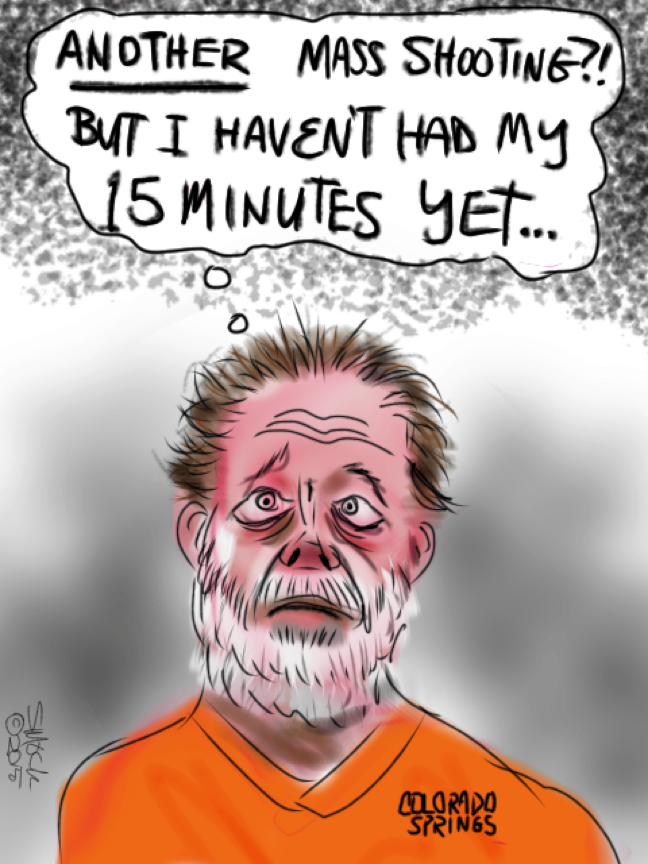
Everyone knows about the mass shooting in the Colorado movie theater, and the school and mall shootings all over the country. Despite how devastating they are to our country's morale, they keep happening. It has evolved into a national issue, and this political cartoon addresses how common these horrible events have become. The man, dressed in an prisoner's classic orange jumpsuit, has just found out that there was another mass shooting, and he seems disappointed about it. His defeated feeling does not stem from the undoubtedly too many lives lost or the fact that this could be prevented, but comes from him now not being able to have his desired "15 minutes of fame."
The artist of this political cartoon is trying to express to the audience the severity of these situations. Yes, the amount of people who are affected by the shootings is astronomical, but the creator wants to communicate that the shootings happen way too often. To make sure that his or her point stands out, they make everything the same font size and shape, yet underlines the word "another." The onlooker is then drawn to that particular word and the meaning of it. Also, by picking a prisoner to express this message speaks volumes. If it was just a regular person saying about how annoyed they were, it would not have the same effect.
The prisoner shown in this cartoon has the power to make the audience angry and deeply affected by the picture because of them being upset over not being able to have their fame if they were to conduct a mass shooting as well. Because of this, I think the author was then able to make their purpose come alive. It was clear what the author was trying to say but it was done in a creative way, which was able to make it that much more effective.
Friday, January 29, 2016
IRB Intro Post #3
For the third marking period, I will be reading The Color of Water by James McBride. He is sharing his mother's story as a tribute to her journey as a white mother of a black son. So far, I've read a Holocaust story, and a humorous autobiography, and I'm excited to read something completely different.
Sunday, January 24, 2016
TOW #16 - "Bossypants" (Part 2)
Tina Fey is not necessarily known for being a world-renowned author, but she definitely showed her more well known skills of being a comedian in her writing. Finishing this book is very bittersweet because while I love reading a book until its end, I will definitely miss her wit and innate humor. While comedy undoubtedly drives this autobiography, allusions and an appeal to logos dominate as well.
The allusions to people like Elvis and Bill Clinton as well as an appeal to logos show that Tina Fey isn't just a funny girl with a pretty face. She knows what she's talking about, and also being able to make jokes about current events allows for her to appeal to a whole other audience. While talking about interacting with black people when she was younger, she says that her "generation carries that with us, only to be constantly disappointed by Kanye West and Taylor Swift" (103). She is flawlessly able to connect to her audience by bringing her own experiences, like interacting with black people for the first time, together with more recent events that even common folk would know and be entertained when reading it.
While I first believed that her purpose was to show that no one is perfect, and that definitely includes celebrities like her, I think it goes farther than that. Tina Fey shared so many embarrassing stories that make her either look like a horrible person or a big freak, and it's to show that anyone can do anything they set their mind to, because it'll eventually work out in the end. I think this book was written for those that need to be able to laugh at themselves, and not be deterred by those that tell them "no" or show that they aren't particularly fond of you. While that really stinks sometimes, it can actually motivate you like it did to Fey. I've personally struggled with this and I can say from my own experience that she was without a doubt able to convince her audience using these rhetorical strategies throughout the book.
The allusions to people like Elvis and Bill Clinton as well as an appeal to logos show that Tina Fey isn't just a funny girl with a pretty face. She knows what she's talking about, and also being able to make jokes about current events allows for her to appeal to a whole other audience. While talking about interacting with black people when she was younger, she says that her "generation carries that with us, only to be constantly disappointed by Kanye West and Taylor Swift" (103). She is flawlessly able to connect to her audience by bringing her own experiences, like interacting with black people for the first time, together with more recent events that even common folk would know and be entertained when reading it.
While I first believed that her purpose was to show that no one is perfect, and that definitely includes celebrities like her, I think it goes farther than that. Tina Fey shared so many embarrassing stories that make her either look like a horrible person or a big freak, and it's to show that anyone can do anything they set their mind to, because it'll eventually work out in the end. I think this book was written for those that need to be able to laugh at themselves, and not be deterred by those that tell them "no" or show that they aren't particularly fond of you. While that really stinks sometimes, it can actually motivate you like it did to Fey. I've personally struggled with this and I can say from my own experience that she was without a doubt able to convince her audience using these rhetorical strategies throughout the book.
Thursday, January 14, 2016
TOW #15 - "Torturing the Saxophone"
This article is taken from lettersofnote.com.
Celebrated Swedish jazz saxophonist Mats Gustafsson sent a copy of his new jazz album to one of his musical idols, Robert Crumb. This album included Gustafsson's new interpretations of some jazz classics by artists like Duke Ellington, Lars Gullin, and the Ayler brothers. He wanted to know Crumb's opinion on his work, but was surprised when Crumb sent back a brutally honest letter about how much he didn't like his fan's musical interpretations. Robert Crumb uses a very insulting tone to get across his point of trying to get Gustafsson to understand that he didn't like how he was playing the classics. But, I think an unintended purpose of Crumb's would be to use this as an opportunity to evaluate himself. At the end, he uses rhetorical questions where he asks himself if he's "too un-hip" or if he's just "a square from Delaware." By just leaving those questions out there, the reader, meaning Mats Gustafsson, is able to hopefully catch on to the fact that Crumb is maybe using this opportunity to adjust himself to a more modern musical world without improvisational music.
While this cruel tone helps him clearly get his point across about his dislike for Gustafsson's modern interpretations, it really just distracts the reader from the what he's honestly trying to say. The observer is just left with feeling bad about a fan being ridiculed horribly by his idol rather than focusing on what he's trying to say, and it prevents the real purpose from being achieved. Crumb says that he can't believe people would pay to watch Gustafsson play, or how shocked he is on how it was such a "negative, unpleasant experience" it was. This title is taken from a note that Crumb wrote on the cover of Gustafsson's CD as an optional album title. He actually wound up using this title and reprinted the letter amongst the liner notes. He used this as a motivation to make better music, and praised Crumb for taking the time to listen to his album.
Celebrated Swedish jazz saxophonist Mats Gustafsson sent a copy of his new jazz album to one of his musical idols, Robert Crumb. This album included Gustafsson's new interpretations of some jazz classics by artists like Duke Ellington, Lars Gullin, and the Ayler brothers. He wanted to know Crumb's opinion on his work, but was surprised when Crumb sent back a brutally honest letter about how much he didn't like his fan's musical interpretations. Robert Crumb uses a very insulting tone to get across his point of trying to get Gustafsson to understand that he didn't like how he was playing the classics. But, I think an unintended purpose of Crumb's would be to use this as an opportunity to evaluate himself. At the end, he uses rhetorical questions where he asks himself if he's "too un-hip" or if he's just "a square from Delaware." By just leaving those questions out there, the reader, meaning Mats Gustafsson, is able to hopefully catch on to the fact that Crumb is maybe using this opportunity to adjust himself to a more modern musical world without improvisational music.
While this cruel tone helps him clearly get his point across about his dislike for Gustafsson's modern interpretations, it really just distracts the reader from the what he's honestly trying to say. The observer is just left with feeling bad about a fan being ridiculed horribly by his idol rather than focusing on what he's trying to say, and it prevents the real purpose from being achieved. Crumb says that he can't believe people would pay to watch Gustafsson play, or how shocked he is on how it was such a "negative, unpleasant experience" it was. This title is taken from a note that Crumb wrote on the cover of Gustafsson's CD as an optional album title. He actually wound up using this title and reprinted the letter amongst the liner notes. He used this as a motivation to make better music, and praised Crumb for taking the time to listen to his album.
Sunday, January 10, 2016
TOW #14 - "Prevent the Madness!"

The United States Forest Service has used Smokey Bear as a symbol of forest fire awareness since 1944, and he has become a very recognizable figure in modern advertising. This advertisement uses that well known symbol in another context, harping on all the waste America creates. Smokey's slogan saying that "only YOU can prevent wildfires" is also used in this ad and manipulated to try to create the recognition that the author used primarily to get their message across. Another great technique that the artist used was to use dark colors except for the fire in the background. If Smokey was a bright blue, despite the fact that a bear is obviously black or brown, it would've taken the focus off of the more prominent issue and the person would instead be looking at Smokey. Also, they put the fire behind Smokey, and it highlights him, so the observer really has no choice but to look at the fire that seems to be the issue the artist was trying to bring to attention. I think that this advertisement was mostly ineffective in being able to convey their message, and it honestly is a bit unclear as to what the author is trying to get at. I don't really know much about this issue and the amount of waste that America produces, and it could have been better represented in this advertisement. Everyone knows who Smokey Bear is and how you can prevent wildfires because it is something that everyone has heard countless times. It was a good idea to highlight that recognition as a way for people to pay attention to the issue at hand, yet it wasn't the best way. I still don't have that big of an idea of what is happening in the picture so in general, it could have been presented in a more effective way.
Subscribe to:
Posts (Atom)