This article is taken from nytimes.com.
Colton Dunn, known writer for the famous show "Key and Peele," recently went to a Hollywood showcase to meet with movie directors and producers. At these showcases, the directors and producers are looking for the "variety types" meaning those who have a different skin color than white or have a different sexual orientation than "straight." Dunn expresses his gratitude for his dad's darker skin color because it has given him jobs in Hollywood, yet he also shares his deep distrust in Hollywood's way of doing things.
By using an anecdote that includes specific details about his experiences in Hollywood, it makes him that much more credible towards the subject, and also provides some humor as well. He tells about how his agent told him to enhance his "black accent" and to really play up the experience he received from being around successful black comedians. It bothers him a lot this agent had to make people change or to enhance their "gayness" just to get a part. He also uses a lot of sarcasm to display how angry he is about this phenomenon that occurs. It provides a nice break from all of the seriousness of the topic because he also brings in the subject of racism.
Dunn connects this occurrence to the Oscars/Academy Awards that are occurring this weekend. Since no black actors were nominated for any of the awards, it caused a major uproar, and this is just more evidence of what Colton is trying to prove: Hollywood is racist, and uses people based on their skin color to make the directors look good for the general public. While Hollywood is making an effort to be more diverse, it can be seen as a step in the wrong direction with this happening, and he uses personal anecdotes and sarcasm to achieve this.
Sunday, February 28, 2016

Sunday, February 21, 2016
TOW #18: "From Heaven"
This letter was taken from lettersofnote.com
Sir William Osler is known by those in the medical field as the writer of "The Principles and Practice of Medicine" or most commonly known as the "Physician's Bible." He became incredibly famous and his contributions to medicine can still be seen today. Unfortunately, a year after his life altering book was published, his newborn son died only after living for a week. This was especially devastating because of Olser's sister's death when she was only two years old. To comfort his wife, William posed as his dead son Paul and wrote as if he were in heaven talking to his mother.
This letter was very depressing to read because of the context behind it but there was also some humor in it that contributed to his purpose. His main goal was to comfort his wife after their heart wrenching loss and also to provide closure, so by having a healthy balance, William was able to be more convincing as a child. The "son" mentions how many kids there are and that it was amazing when he found out that everyone from around the world goes to the same place. He also mentions that people are put into six different divisions based on their age and how weird that was for him. By speaking so innocently, he was probably able to capture the embodiment of the character that he was playing a lot more and be more convincing.
Another way that William made this letter come alive was through the effective use of imagery. In the beginning of the letter, "Paul" describes what heaven looks like. He mentions the green spot that he woke up in with all the trees and how pretty it all was. It paints such a beautiful picture for William's wife to have in her mind so that she can feel better about where her son is now. Also with not knowing anything for sure about heaven, having that visual in her head, if she believes William, can help her to eventually cope with what happened. Through the use of these strategies, Osler was able to convince his wife that everything was going to turn out fine and that she shouldn't be worried.
Sir William Osler is known by those in the medical field as the writer of "The Principles and Practice of Medicine" or most commonly known as the "Physician's Bible." He became incredibly famous and his contributions to medicine can still be seen today. Unfortunately, a year after his life altering book was published, his newborn son died only after living for a week. This was especially devastating because of Olser's sister's death when she was only two years old. To comfort his wife, William posed as his dead son Paul and wrote as if he were in heaven talking to his mother.
This letter was very depressing to read because of the context behind it but there was also some humor in it that contributed to his purpose. His main goal was to comfort his wife after their heart wrenching loss and also to provide closure, so by having a healthy balance, William was able to be more convincing as a child. The "son" mentions how many kids there are and that it was amazing when he found out that everyone from around the world goes to the same place. He also mentions that people are put into six different divisions based on their age and how weird that was for him. By speaking so innocently, he was probably able to capture the embodiment of the character that he was playing a lot more and be more convincing.
Another way that William made this letter come alive was through the effective use of imagery. In the beginning of the letter, "Paul" describes what heaven looks like. He mentions the green spot that he woke up in with all the trees and how pretty it all was. It paints such a beautiful picture for William's wife to have in her mind so that she can feel better about where her son is now. Also with not knowing anything for sure about heaven, having that visual in her head, if she believes William, can help her to eventually cope with what happened. Through the use of these strategies, Osler was able to convince his wife that everything was going to turn out fine and that she shouldn't be worried.
Monday, February 15, 2016
TOW #17: "15 Minutes of Fame"
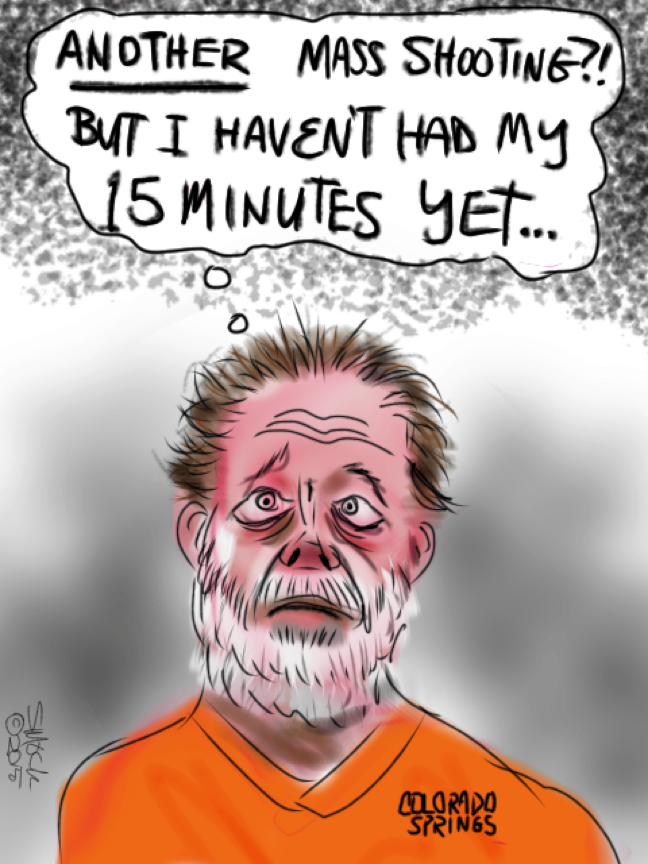
Everyone knows about the mass shooting in the Colorado movie theater, and the school and mall shootings all over the country. Despite how devastating they are to our country's morale, they keep happening. It has evolved into a national issue, and this political cartoon addresses how common these horrible events have become. The man, dressed in an prisoner's classic orange jumpsuit, has just found out that there was another mass shooting, and he seems disappointed about it. His defeated feeling does not stem from the undoubtedly too many lives lost or the fact that this could be prevented, but comes from him now not being able to have his desired "15 minutes of fame."
The artist of this political cartoon is trying to express to the audience the severity of these situations. Yes, the amount of people who are affected by the shootings is astronomical, but the creator wants to communicate that the shootings happen way too often. To make sure that his or her point stands out, they make everything the same font size and shape, yet underlines the word "another." The onlooker is then drawn to that particular word and the meaning of it. Also, by picking a prisoner to express this message speaks volumes. If it was just a regular person saying about how annoyed they were, it would not have the same effect.
The prisoner shown in this cartoon has the power to make the audience angry and deeply affected by the picture because of them being upset over not being able to have their fame if they were to conduct a mass shooting as well. Because of this, I think the author was then able to make their purpose come alive. It was clear what the author was trying to say but it was done in a creative way, which was able to make it that much more effective.
Subscribe to:
Posts (Atom)